
A blockchain now runs on the same matrix multiplication as AI, at about 90 EH/s. I read its code, its chain data and the economics around it to answer three questions: what in AI × crypto has paying customers, when an ASIC is worth building, and which process node fits which chip. With the full report and slides.
Abstract
Pearl, launched in April 2026, is the first blockchain whose proof of work is AI-style matrix multiplication at scale. On November 13, 2026 its network ran at about 90 EH/s, where one H is one INT7 multiply-accumulate: the integer throughput of about 122,000 H100s. It works as engineering. It is not yet useful: about 1% of blocks carry real AI work, because a GPU that mines while serving inference keeps only 1% to 27% of a dedicated miner's hashrate. Across AI × crypto, verifiable paid demand shows up in three places, selling inference, selling data and selling privacy, while subsidies run from 4 to 360 times outside revenue. For chips, an ASIC's profit ceiling is the revenue per unit of compute times (1 − 1/k), so efficiency beyond k = 5 adds little; what decides is the size of the pot, the stability of the rules and a second market. No network offers all three today. The right process node is set by the largest item in a chip's lifetime cost, and the chip itself should be bought in stages, so that a rule change costs a prototype rather than a tape-out.
Why I looked at this
I have spent many years designing chips, including full-custom ASIC datapaths for cryptocurrency mining, and I now work on AI. When a chain appeared whose security budget is literally priced in tensor throughput, the questions for someone like me were obvious: is the work useful, would a dedicated chip win, and what would it cost to build one?
I read Pearl's code and protocol proposals, chain data from an independent full node, company filings, papers in cryptography, computer architecture and machine learning, foundry and vendor price data, and the trade press. Every number below is as of November 13, 2026, and money is in US dollars. This note is how I learned the field; I share it so that others can check it, use it and argue with it. The full report, with all the sources, is at the end.
Results at a glance
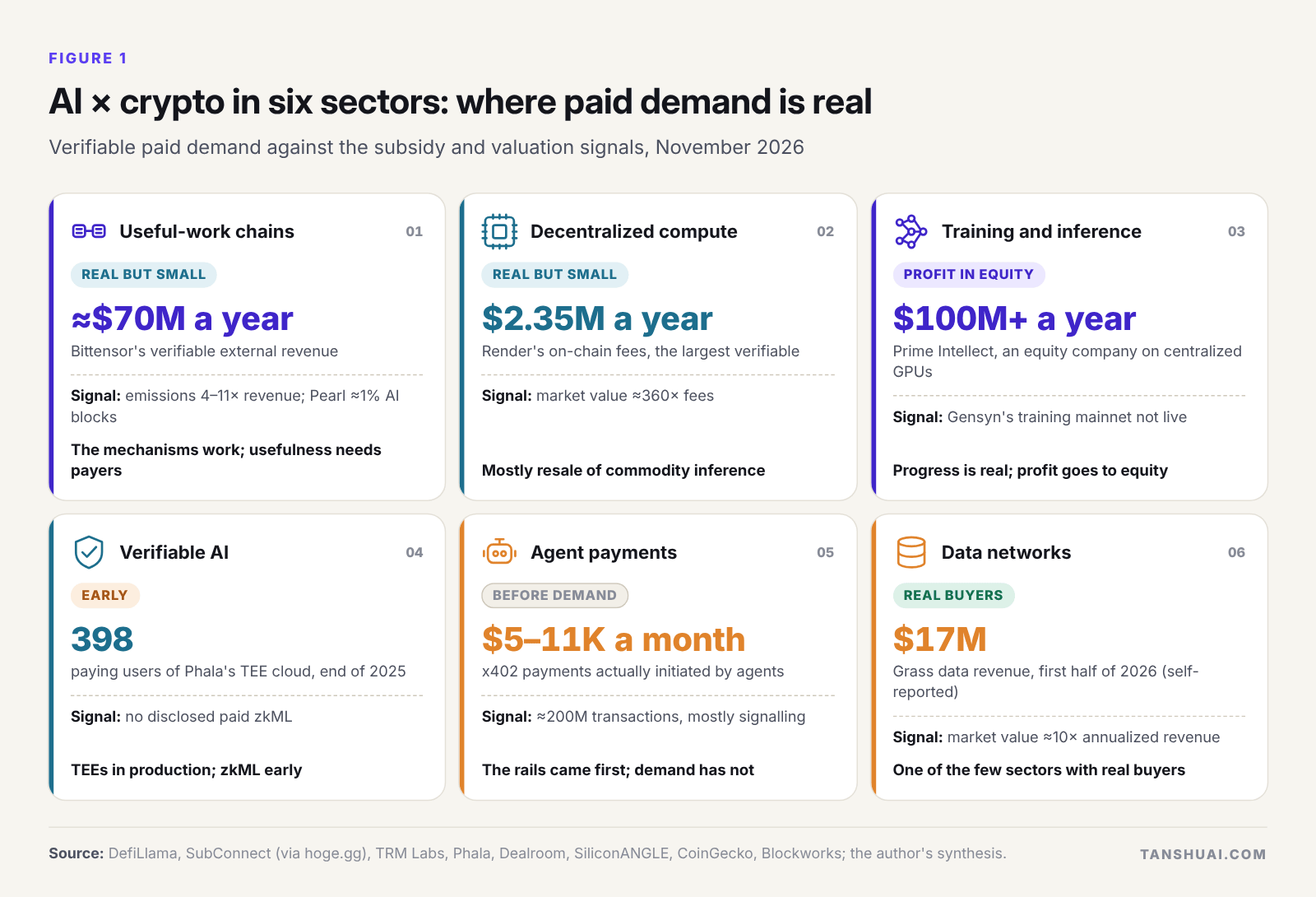 Figure 1. AI × crypto in six sectors: where paid demand is real.
| Question | Short answer |
|---|---|
| Does Pearl work, and is its work useful? | It works: about 90 EH/s of matrix multiplication secures the chain. It is not yet useful: about 1% of blocks carry AI work |
| Where is the real paid demand? | Inference, data and privacy. Agent payments, zkML and decentralized training are still before demand |
| Is an ASIC worth building? | Only with a large pot, stable rules and a second market; no network offers all three today |
| Which chips should a small team build? | Inference-first accelerators that can also mine, inference chips for a signed customer, early FHE work; not merchant bitcoin miners or training chips |
| What does a first chip cost? | Buy it in stages: a model, an FPGA and an MPW reach measured silicon for about $1.5 million, before masks that cost millions |
Pearl: one multiply-accumulate is one hash
Pearl rests on a 2025 result by Ilan Komargodski and Omri Weinstein: a proof of useful work for any matrix product, at 1 + o(1) times the cost of the multiplication. Miners multiply noisy matrices, hash each output tile's accumulator into a lottery ticket and prove the winning tile with a zero-knowledge proof of under 60 KB. In the consensus code, one H is one credited INT7 × INT7 → INT32 multiply-accumulate, so for the first time a blockchain's security budget is priced in the tensor throughput of AI accelerators.
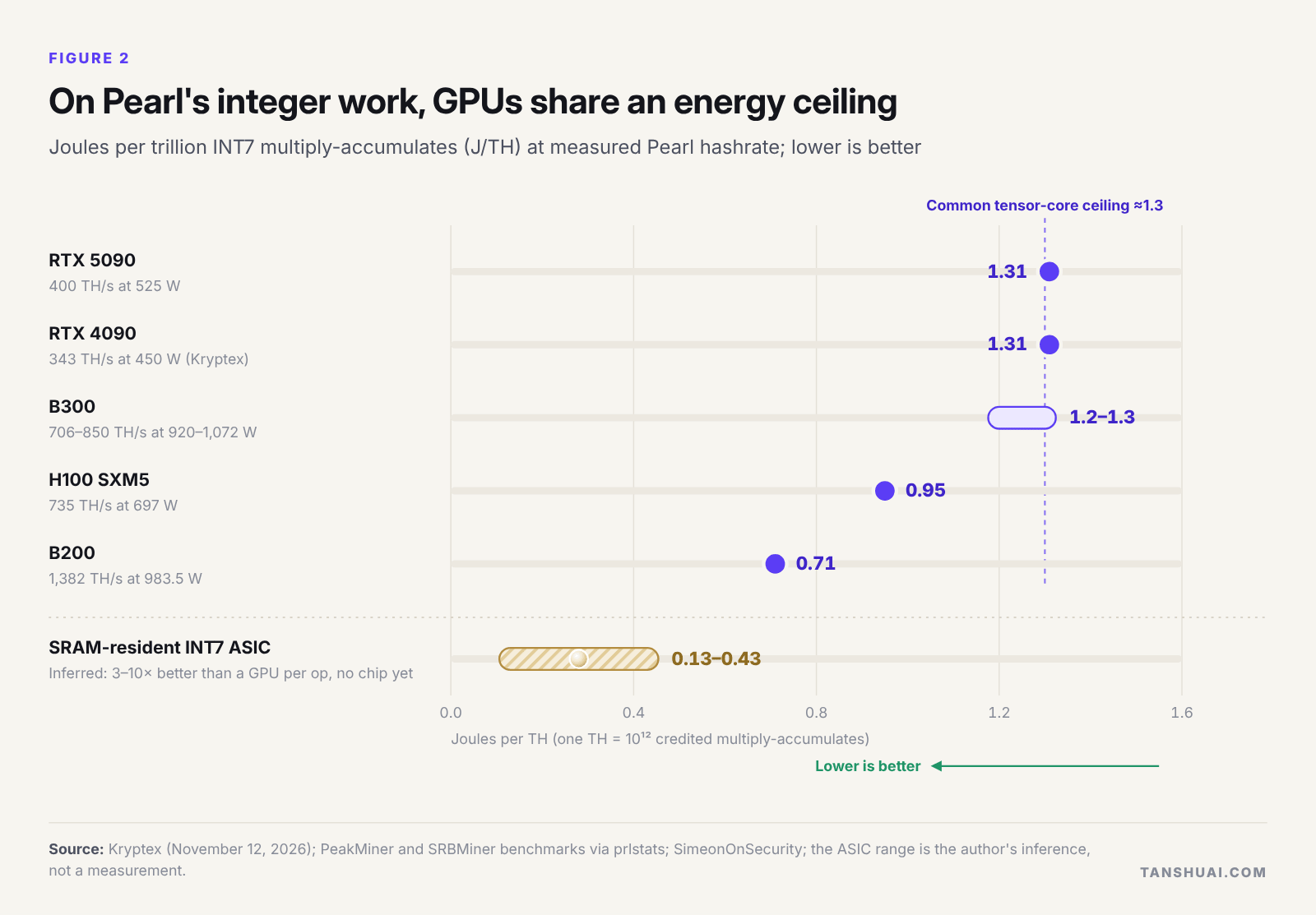 Figure 2. On Pearl's integer work, GPUs share an energy ceiling.
Gaming cards and the data-center B300 meet at about 1.3 J/TH, and even the B200 reaches only 0.71. That shared ceiling is exactly what a dedicated chip could break: a part that only multiplies 7-bit integers from on-chip SRAM, with no HBM or general-purpose units, could plausibly do 3 to 10 times better per operation. Meanwhile NVIDIA is moving its newest silicon away from INT8 towards FP8 and FP4, which is why Pearl is preparing to change its arithmetic.
Pearl's economics: the theorem holds, the incentive does not
Pearl's hashrate follows its price. The network went from 0.01 EH/s on its second day to 23–26 EH/s at the end of May, held at 21–39 EH/s through a summer in which the price fell about 86%, and reached about 90 EH/s after the price rose about tenfold in the autumn. About 120 million coins, roughly 32% of today's supply, were mined in the first six days, and supply will grow by about 78% in the next 12 months. An RTX 5090 now earns about $5–6 a day.
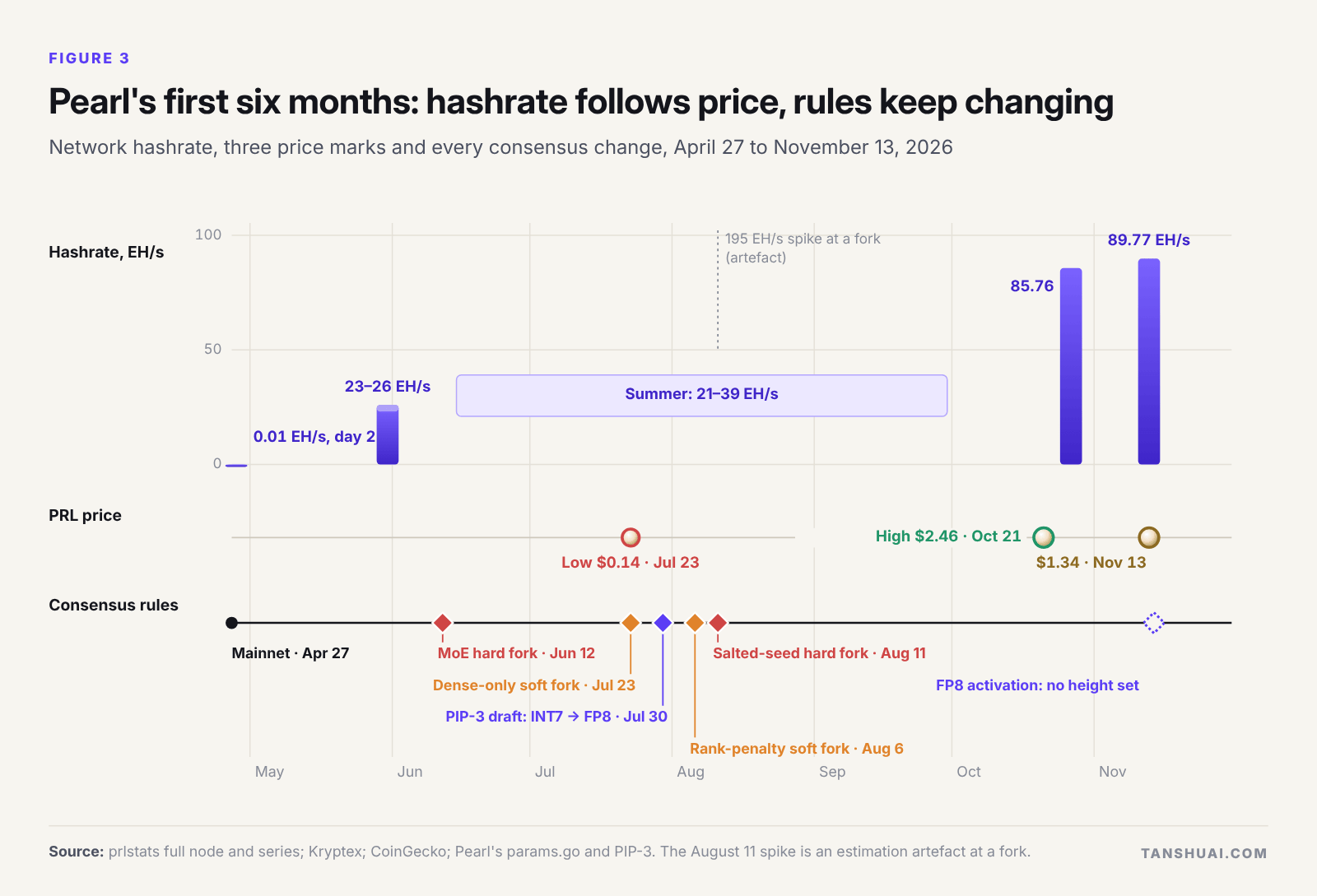 Figure 3. Pearl's first six months: hashrate follows price, rules keep changing.
The useful part is where the model breaks. Mining inside real inference costs little on the inference side, about 5% to 9% of throughput, but earns little on the mining side: Pearl's plug-in mines only on long prefill batches, so a card serving a chat workload keeps about 5% of a dedicated miner's hashrate. Rational miners therefore multiply random matrices, and the protocol cannot tell. The one public inference partnership is no longer on its provider's serverless API. Pearl's usefulness is an off-chain commercial problem: someone has to pay for the inference.
The rules are the other risk. In June to August the lab activated four consensus changes at hard-coded heights, and its draft PIP-3 moves mining to FP8 with bit-exact device profiles for only two NVIDIA architectures. A number format can be useful for AI, verifiable bit for bit and hardware-neutral, but at most two of the three.
Across AI × crypto: subsidy is fuel, not a business model
Other useful-work chains tell the same story. Kaspa put a matrix product inside its hash and got ASICs within 16 months anyway; its best machine now earns $0.86 a day. Aleo's synthetic proving puzzle got dedicated hardware in five months and paid provers 175–180 times its fees. Bittensor is the only network in the group with outside revenue at scale, about $70 million a year, against more than $300 million of emissions.
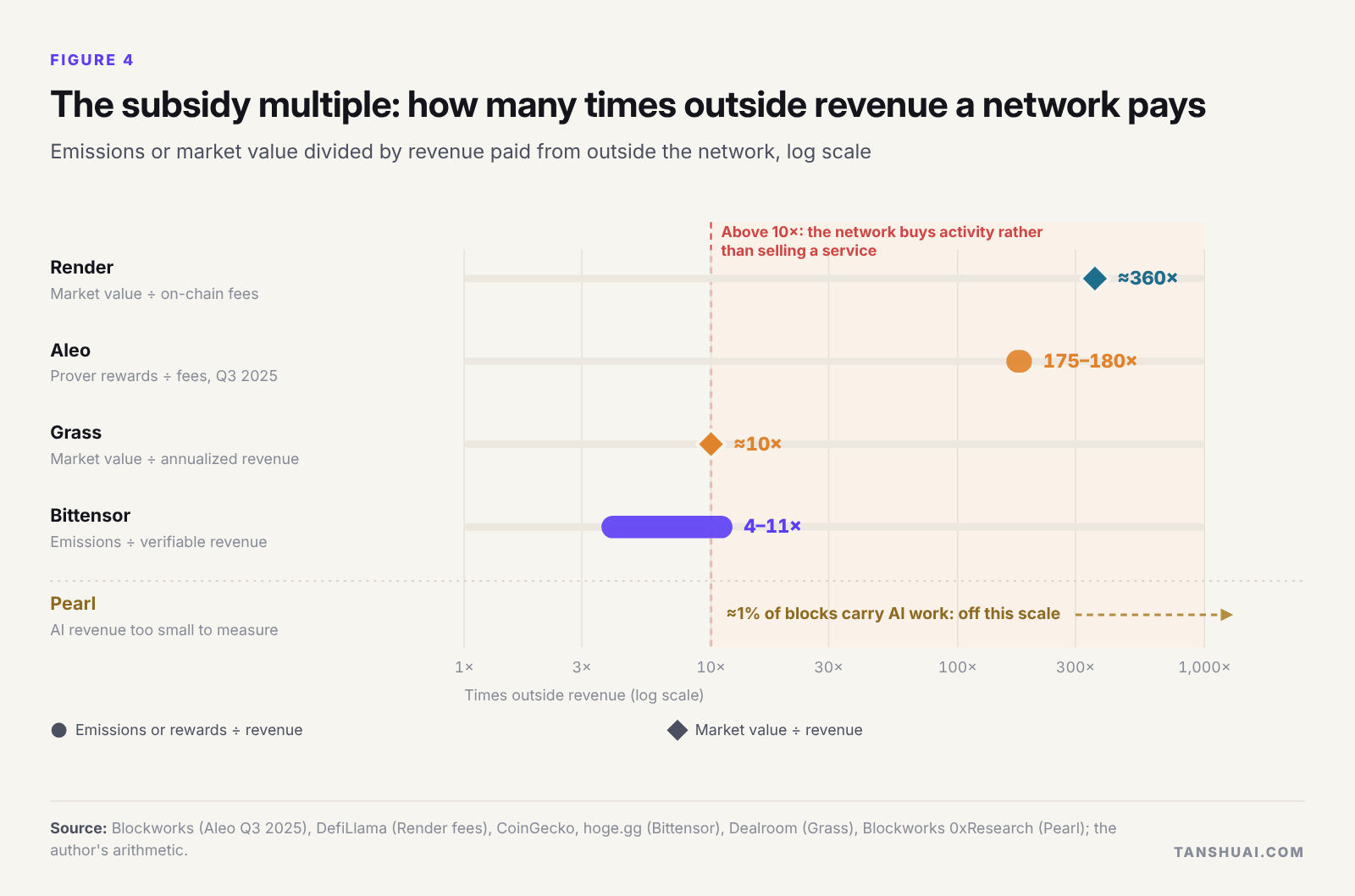 Figure 4. The subsidy multiple: how many times outside revenue a network pays.
Beyond consensus, the picture is real demand at small scale. Decentralized GPU markets sell commodity inference and beat the hyperscalers' prices but not the cheapest neoclouds. Training over the internet works at 8 to 40 billion parameters, while frontier runs went back to centralized clusters. Trusted execution environments run confidential inference in production; zero-knowledge proofs of AI are still in the lab. Payments initiated by AI agents come to about $5,000–11,000 a month despite rails built by Visa, Mastercard, Stripe and Google. Data is one of the few sectors with real buyers. Meanwhile four equity companies on centralized infrastructure are worth about as much as all the protocol- and application-layer AI tokens together: crypto does distribution and settlement, and equity takes the profits.
When an ASIC pays: one formula, three yardsticks
When GPUs set the price of mining, revenue per unit of compute tends to their cost, and an ASIC that is k times cheaper keeps at most (1 − 1/k) of revenue. The curve is concave: 50% at k = 2, 80% at k = 5, 90% at k = 10. Beyond k = 5, more efficiency adds little profit; and against idle GPUs that pay only for electricity, the effective k may be only about 2.5.
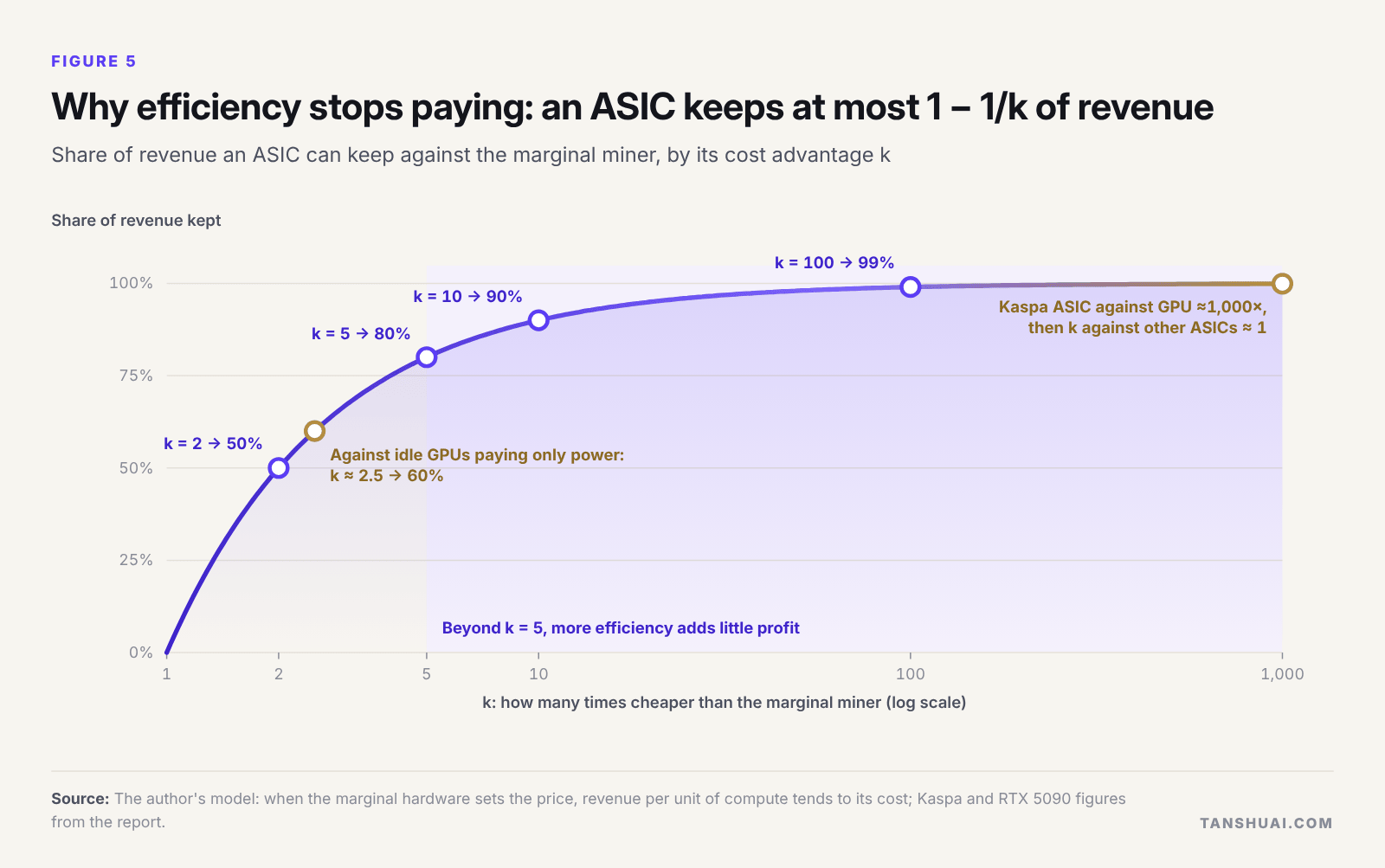 Figure 5. Why efficiency stops paying: an ASIC keeps at most 1 − 1/k of revenue.
Three yardsticks then decide: the pot, the payback scale and the rules. Bitcoin miners earn about $11.5 billion a year, Pearl's about $0.46–0.49 billion, Aleo's about $31 million and Kaspa's about $18 million, less than the low end of one 5/4 nm chip design. For Pearl, a $20 million chip with k = 5 needs about 4.9 EH/s running for a year to pay back if the rules hold, and twice that if they hold only with even odds.
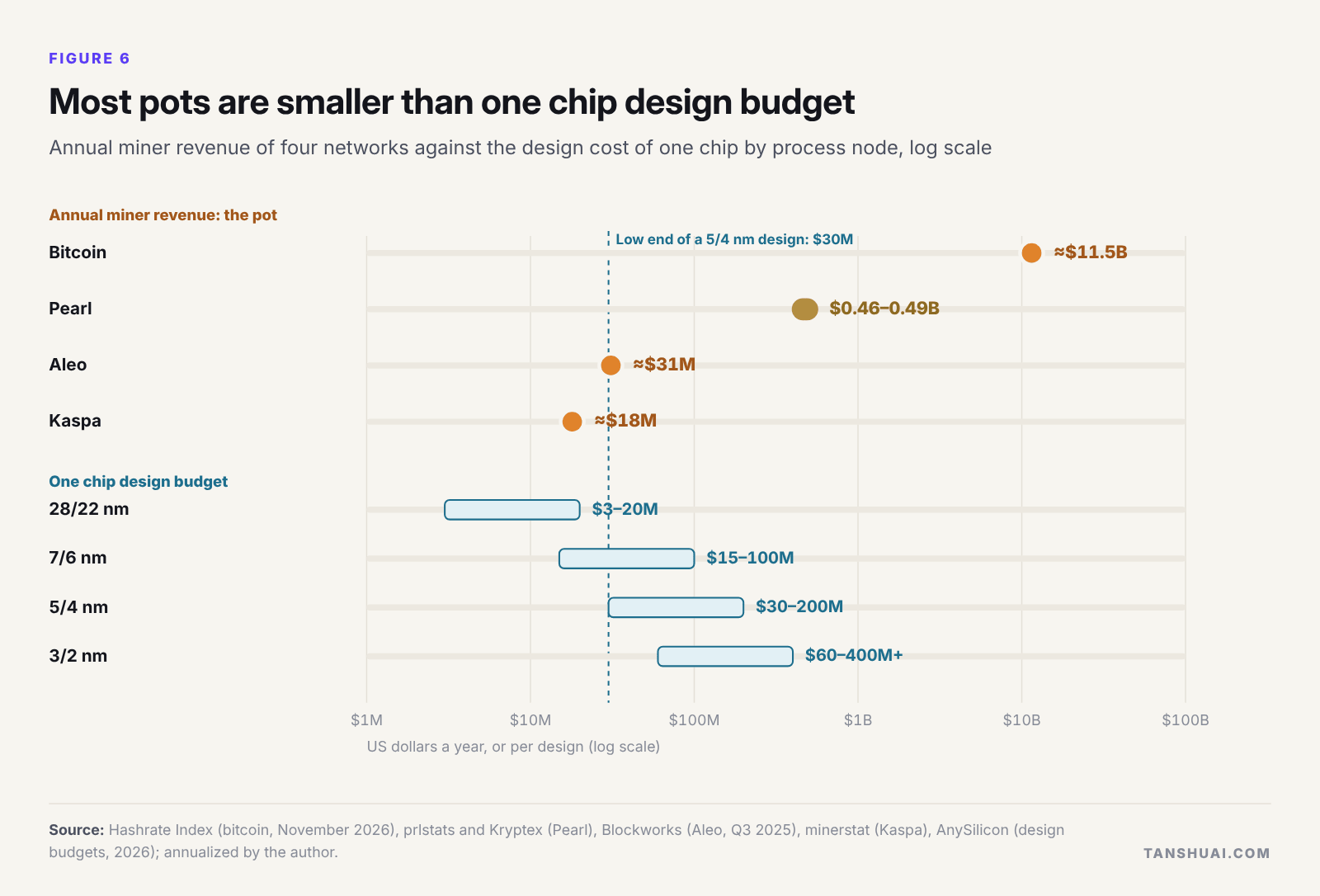 Figure 6. Most pots are smaller than one chip design budget.
Today no network offers a large pot, stable rules and k above 1 at the same time: bitcoin's k belongs to the incumbents, Pearl's rules are the least stable, and Kaspa's and Aleo's pots are too small.
Five chip types, five answers
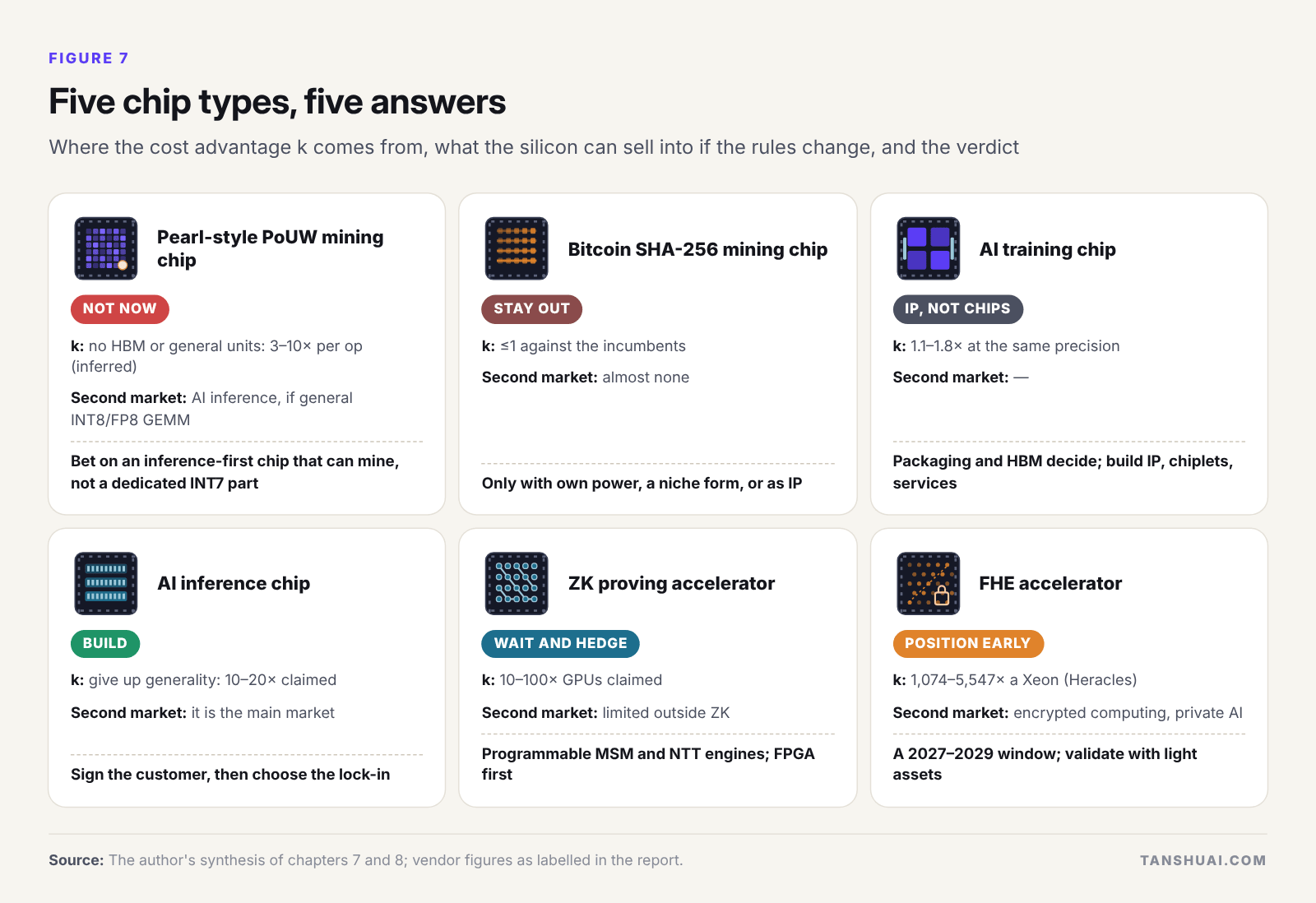 Figure 7. Five chip types, five answers.
For Pearl, I would not tape out a dedicated INT7 chip now: a new team needs 18 to 24 months, and the protocol may have moved to FP8 by then. The better bet is an inference-first accelerator built on general INT8/FP8 GEMM with operands in SRAM, so that the silicon has a second market if mining access is closed. A new team should stay out of the merchant bitcoin-miner market, where Bitmain ships 8.9 J/TH machines and challengers are retreating; power sites are now worth more as AI data centers than as mines. Small teams should not build stand-alone training chips. Inference chips are worth building for a signed customer, ZK accelerators are a hedge, and FHE accelerators are an early position for 2027–2029.
Process nodes and a staged budget
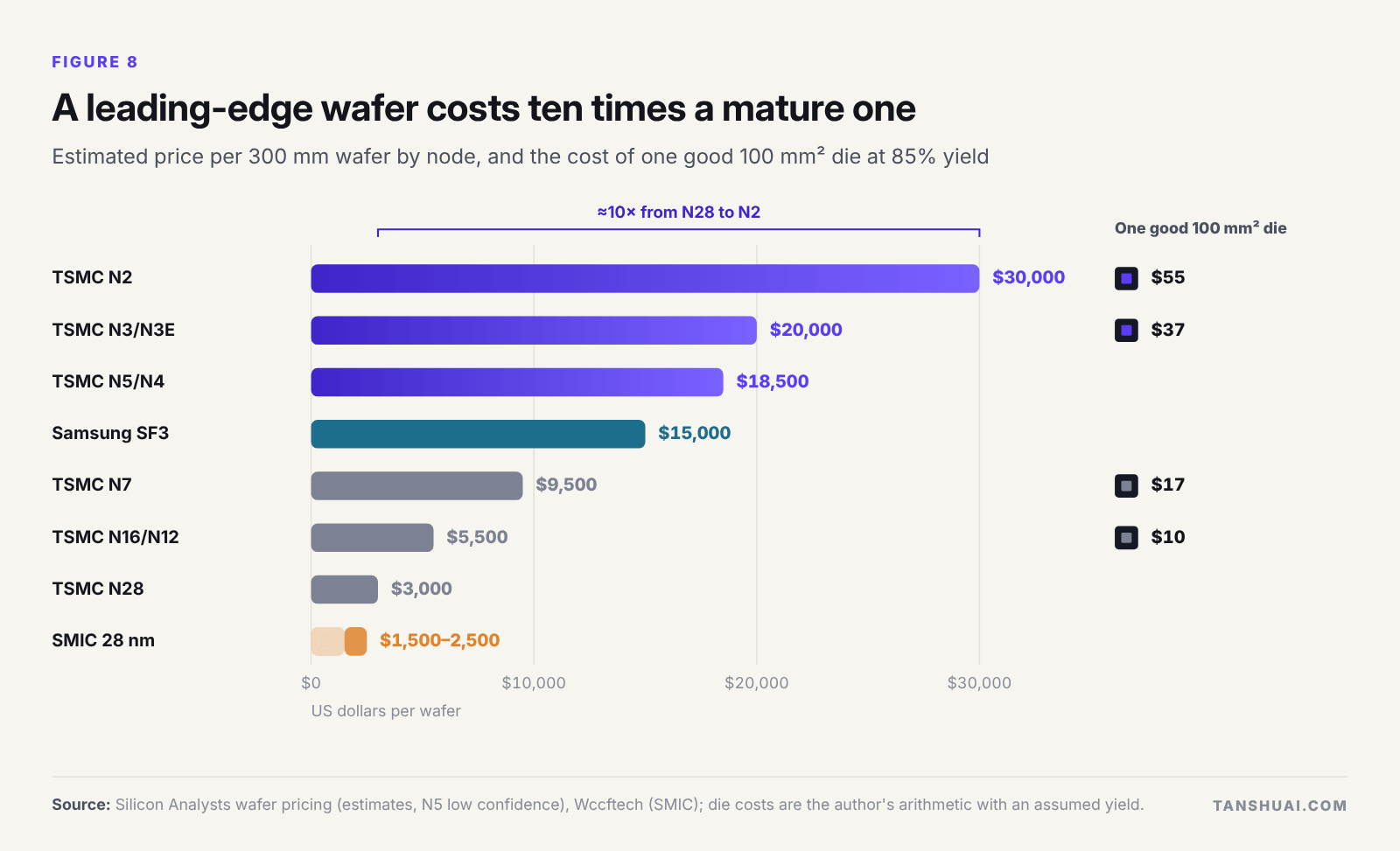 Figure 8. A leading-edge wafer costs ten times a mature one.
Let the largest item in the chip's lifetime cost choose the node: energy for compute chips that run around the clock, packaging and HBM for training chips (about 63% of an H100's cost), and the choice between SRAM and HBM for inference chips. A PoUW mining chip can be prototyped on 28 or 16/12 nm multi-project wafers and move to N7/N6 and then N5/N4 only once the algorithm and revenue are stable.
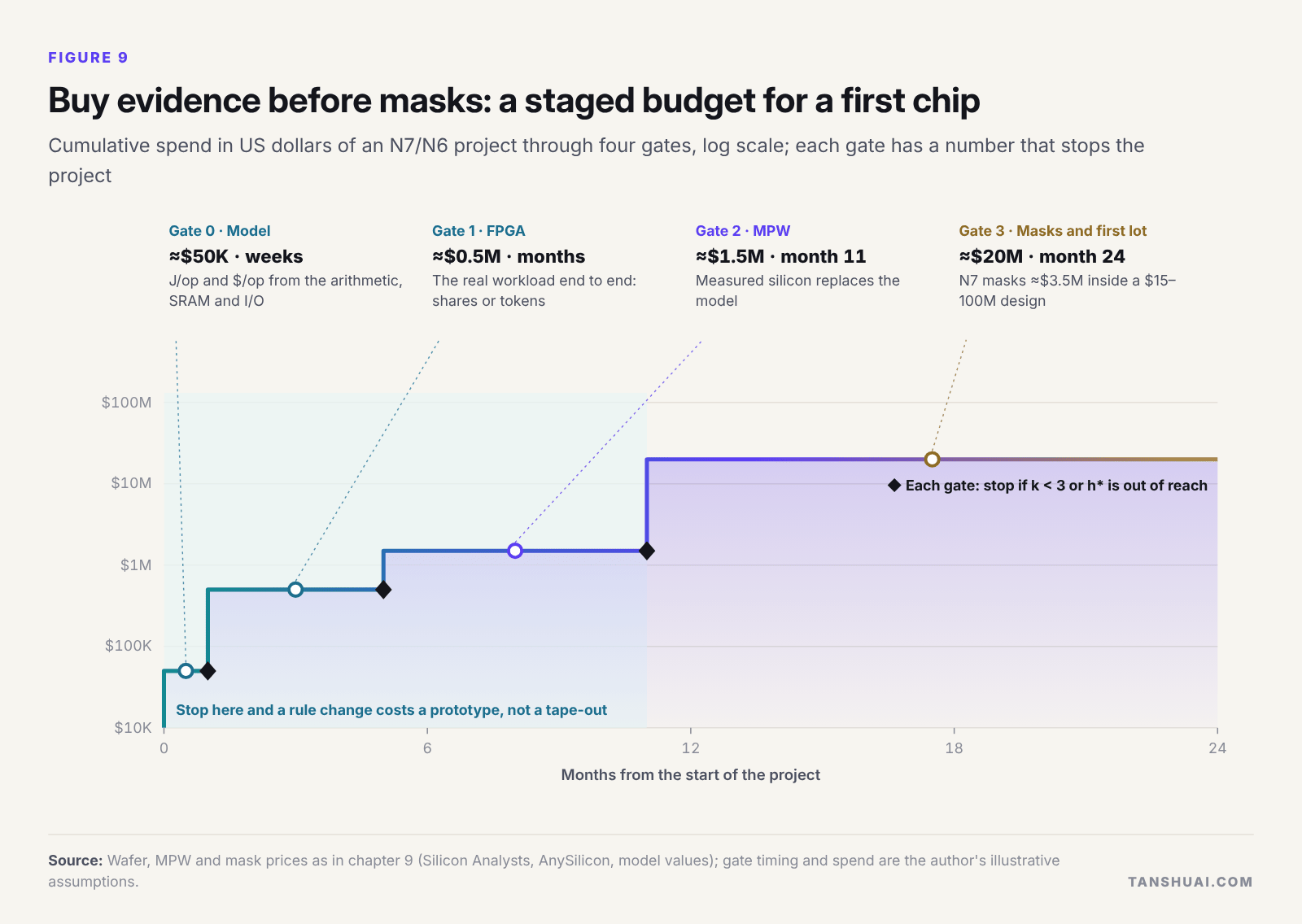 Figure 9. Buy evidence before masks: a staged budget for a first chip.
A first chip should be bought in four stages, each with a number that stops the project: a model of J/op and $/op, an FPGA running the real workload, a multi-project wafer, and only then a mask set. On N7/N6 the first three cost about $1.5 million and eleven months; the mask set and first lot cost more than ten times as much [estimate]. If the protocol changes its arithmetic or the buyer walks away, a team that stopped at the wafer loses the price of a prototype, not of a tape-out. The cheapest efficiency is architectural: keeping operands in SRAM and leaving out HBM removes most of a GPU's cost before any node is chosen.
Where I would start
The opportunities lie where the fields cross: crypto as the first customer, AI as the second market. Demand for custom chips in 2026 is overwhelmingly AI, and the skills of a mining-chip team, low-voltage arrays, kilowatt power delivery and fast tape-outs, transfer directly. I would take at most three paths, each tested with a small first step: an inference-first accelerator that can also mine, starting with a four-week J/op and $/op study; custom-silicon services with crypto as the first customer, starting with paid feasibility studies; and an AI-native network that signs its compute buyer before designing its token.
Download the full report and slides
The full report covers Pearl's mechanism, economics and rules in detail, the other useful-work chains and the wider AI × crypto landscape, the ASIC model with its payback arithmetic, chip-by-chip verdicts, node costs and choices, a staged budget for a first chip, a list of signposts and all the sources.
Questions you did not ask but should have
Before putting money or silicon into any AI × crypto project, I would ask: who controls the work function; what the subsidy multiple is; what the next gate costs and what number stops you; what the payback hashrate is, with p; what the chip's second market is; whether the value lands in the token or in the equity; and who the first paying customer is, by name.
These are areas we can explore together, through technical exchange and technical collaboration: custom chips for mining, AI training and inference, and accelerators; AI development; and AI × crypto systems from chain to node to chip. You can reach me at i@tanshuai.com.
About the author
Tan Shuai is a technologist and founder with more than twenty years of work across chips, hardware and system software, and 20 granted patents. He has many years of fabless chip R&D and management behind him, including full-custom ASIC datapath design for cryptocurrency mining chips and multimedia camera chips. His work has taken him through Silicon Valley, New York, Chicago, Taiwan, the Greater Bay Area (Shenzhen and Hong Kong), Vietnam and Malaysia. Today he works as an AI researcher and developer.
Technical discussion: i@tanshuai.com.